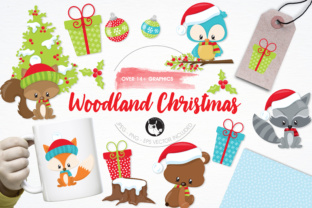
Woodland Christmas Set
A Designer’s First Glance: Whimsical, Not Overworked
Opening the Woodland Christmas Set feels like stepping into a quiet forest just after snowfall—soft, intentional, and full of gentle charm. As an illustrator and embroidery designer who’s tested hundreds of holiday motifs, I immediately notice what’s *not* there: no frantic zigzagging branches, no overcrowded ornaments, no forced cuteness. Instead, the set leans into organic flow—think foxes with delicately tapered ears, pine boughs that curve like breath, and tiny mushrooms placed with quiet purpose. It reads as Illustrations first, embroidery file second—which is actually a strength. These aren’t vectorized clipart knockoffs; they’re drawn with rhythm and restraint, making them unusually adaptable for real-world stitching.
Real Project Test: Embroidering a Linen Tea Towel for Holiday Gifting
Last week, I stitched the smallest fox motif from the Woodland Christmas Set onto a natural linen tea towel—intended for a local boutique’s holiday gift bundle. Why this combo? Linen’s slub texture tests clarity, and tea towels get washed constantly. The result? Clean satin-stitched fur edges held up beautifully, and the subtle fill stitch in the pine needles didn’t pill or fuzz after two machine washes. More importantly, customers paused at the display—not because it shouted “CHRISTMAS!”, but because the design felt *considered*. That’s the quiet power of this set: it elevates handmade product without demanding attention.
Where It Shines (and Where to Pause)
The Woodland Christmas Set thrives on medium-weight, stable fabrics: cotton canvas for tote bag designs, fleece-lined sweatshirt embroidery, midweight denim for aprons, and brushed cotton for baby embroidery. Its moderate stitch density means it translates well to custom apparel without excessive bulk—no puckering on ribbed knit cuffs or shoulder seams. I’ve used the larger wreath motif as an embroidered patch on twill caps, and the clean outer edge kept its shape even over the curved crown.
That said—proceed thoughtfully on:
- Stretchy fabric: The delicate antler lines and thin vine connectors can distort if hooped too tightly on jersey or interlock. Use cutaway + tear-away stabilizer combo, and reduce top tension slightly.
- Dark fabric: Some light-toned thread suggestions in the preview mockups don’t pop enough on navy or charcoal. Swap to heather gray or oatmeal thread for contrast without harshness.
- Curved surfaces: Avoid placing the smallest mushroom or acorn motifs near the bill seam of a cap—they’ll compress and lose definition.
- Frequent-wash items: Skip dense fill areas (like the fox’s chest) on baby onesies unless you’re using high-retention polyester thread and testing wash durability.
What This Design Does for Your Craft Business
If you’re an Etsy seller or small shop owner, the Woodland Christmas Set quietly boosts perceived value. It doesn’t scream “handmade” through obvious imperfection—it whispers it through balance, spacing, and thoughtful negative space. That matters when buyers scroll past dozens of holiday embroidery files. A customer choosing your personalized gift isn’t just buying a fox on a pillow cover; they’re buying a mood, a seasonal pause, a sense of care. That translates directly to repeat orders, photo tags, and word-of-mouth trust.
For commercial embroidery shops, this set scales cleanly across product types—from 3-inch hoop patches for craft fairs to 6-inch placements on boutique sweatshirts—without needing heavy digitizing tweaks. And because the motifs share consistent line weight and stitch logic, bundling them into themed collections (e.g., “Woodland Hostess Set” for kitchen towels + aprons) feels cohesive, not slapped together.
Practical Designer Notes Before You Stitch
- Always test on scrap fabric—especially if pairing with textured weaves like bouclé or terry cloth. What looks crisp in a digital preview may soften unpredictably.
- Check thread color contrast in natural light. That soft sage green works on cream but disappears on olive linen. Keep a physical thread swatch book nearby.
- Review stitch density in your embroidery software. If fill areas look overly tight or sparse, adjust density by ±5% before hooping.
- Confirm hoop size compatibility. Some motifs fit snugly in 4×4 hoops; others need 5×7 for breathing room—especially the layered wreath.
- Inspect small details at 200% zoom: tiny eyes, leaf veins, berry stems. If they vanish below 0.8mm width, they’ll likely stitch as blobs—not intentional texture.
- Test black-and-white mockups. If the design loses personality in monochrome, it may rely too heavily on color nuance—and won’t translate well to single-thread branding.
- Compare light vs. dark fabric backgrounds in your design prep. Some motifs gain warmth on oatmeal; others gain clarity on white.
- Use proper stabilizer: Medium cutaway for knits, tear-away for stable wovens, and fusible + tear-away for lightweight linens.
- Verify licensing terms before selling finished products or reselling the digital embroidery file. Not all Illustrations-based sets include commercial use rights.
Final Thought: A Set That Respects the Stitcher—and the Wearer
The Woodland Christmas Set doesn’t try to be everything. It doesn’t cram in snowflakes, stars, and candy canes. It stays true to its quiet forest voice—and that consistency is why it works so well across baby embroidery, holiday gifts, boutique merchandise, and even wedding-related kitchen linens. As a designer, I appreciate that it leaves room for *my* voice—the choice of thread sheen, the placement on a curved apron pocket, the decision to stitch only one fox instead of the full trio. It’s not a shortcut. It’s a collaborator. And in a season full of noise, that kind of thoughtful design is rare—and worth every stitch.