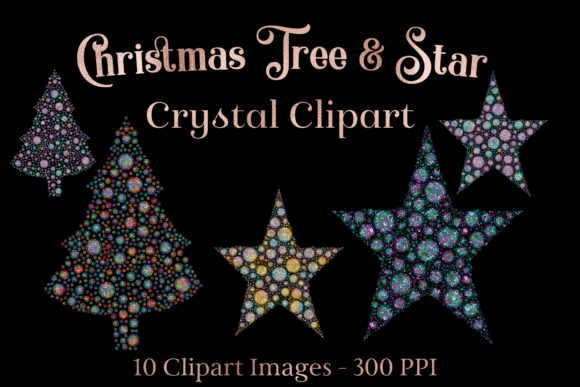
Christmas Tree and Star Crystal Clipart Illustrations
As a graphic designer who’s built brand identities for handmade businesses, launched seasonal campaigns for Etsy sellers, and crafted packaging for boutique holiday collections, I recently evaluated Christmas Tree and Star Crystal Clipart for a real client project: a limited-edition line of hand-poured soy candles sold through local markets and Instagram. The goal was cohesive, elevated holiday visuals—neither kitschy nor overly minimalist—that could scale across labels, social posts, website banners, and printable gift tags. Here’s how this asset performed under professional scrutiny.
A First Impression That Sets the Tone
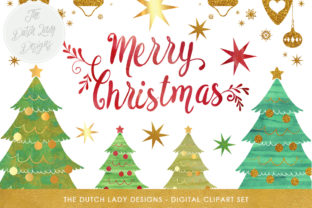
The Christmas Tree and Star Crystal Clipart opens with delicate linework, subtle gradient shimmer on the star, and a softly faceted tree silhouette that reads as both elegant and warm. It leans into modern illustration—not cartoonish, not photorealistic—but intentionally refined. There’s a quiet luxury here: think artisanal apothecary, not big-box retail. That mood immediately aligned with my client’s positioning: small-batch, intentional, emotionally resonant. For brands rooted in craftsmanship—whether candle makers, ceramicists, or stationery designers—this isn’t just clipart; it’s a graphic design asset that signals care in execution.
Where It Shines in Real Client Work
In practice, Christmas Tree and Star Crystal Clipart excels where visual storytelling meets functional design:
- Product mockups: Placed on matte-finish candle jar labels, it added festive focus without overwhelming the clean typography—especially when scaled to 1.2 cm tall on a 75 mm diameter label.
- Social media graphics: Used as a central motif in Instagram carousels and Pinterest pins, it anchored seasonal promotions while leaving ample breathing room for copy and CTAs.
- Printable designs: As part of a downloadable holiday planner bundle, its crisp edges and transparent PNG background ensured sharp printing on both home inkjets and commercial presses.
- Cricut projects & sublimation design: The vector-ready SVG file held detail at any size—even when cut from glitter vinyl or printed onto ceramic mugs—and retained smooth curves during resizing.
- Brand identity extensions: Paired with a warm serif (like Playfair Display) and a neutral sans (like Inter), it reinforced seasonal cohesion across email headers, website hero sections, and digital ads—without requiring custom illustration.
It also worked beautifully as a decorative accent—repeated subtly along the spine of a holiday catalog, scattered across a tote bag design, or layered behind a handwritten “Merry & Bright” invitation. In themed collections—especially those targeting creative marketplaces or print-on-demand platforms—it functions as a unifying visual thread.
Where to Use It Thoughtfully
This isn’t a one-size-fits-all design bundle element. Its ornamental detail demands context. Avoid using Christmas Tree and Star Crystal Clipart in:
- Small-scale applications like favicon icons or tiny app badges—fine details blur below 24 px.
- Crowded layouts where competing patterns or dense text reduce legibility and emotional impact.
- Low-contrast environments, especially over busy photographic backgrounds—test it against your actual imagery before finalizing.
- Minimalist or corporate branding (e.g., law firms, fintech dashboards)—its warmth and ornamentation may clash with strict visual hierarchy expectations.
It’s also not ideal for projects demanding stark neutrality. If your client’s brand voice is “quiet luxury meets architectural precision,” lean toward monoline or geometric alternatives instead.
Designer Notes You Can’t Skip
Before deploying Christmas Tree and Star Crystal Clipart in a client deliverable, I always run these checks:
- Test in black and white: Does the shape retain clarity? (It does—the silhouette holds up cleanly.)
- Check contrast on light AND dark backgrounds: The star’s subtle glow can fade on mid-tone grays—stick to pure white or deep navy for best results.
- Preview at intended sizes: Zoom out to 25% in your layout software—does it still read as a cohesive symbol?
- Place it on real mockups, not just flat previews—see how it interacts with texture, lighting, and material realism.
- Confirm print quality: Run a test print on your target stock—some PNGs lose subtlety on uncoated paper unless saved at 300 DPI.
- Inspect transparency: The included PNG has clean alpha channels—no fringing or haloing—critical for sticker design and web use.
- Verify SVG editability: Paths are fully scalable and layer-named, making color swaps and minor tweaks fast in Illustrator or Figma.
- Compare with typography: It pairs best with warm serifs and friendly sans serifs—not ultra-thin displays or aggressive scripts that compete for attention.
- Confirm commercial license: This is non-negotiable. The asset includes broad commercial rights—perfect for Etsy product listings, Canva templates, and print-on-demand storefronts—but always double-check the license terms before delivery.
Why It Earned a Spot in My Client Toolkit
In the end, Christmas Tree and Star Crystal Clipart delivered what matters most in client-facing work: speed without sacrifice. It accelerated our timeline without diluting brand integrity. It supported emotional resonance—evoking nostalgia and elegance—while remaining versatile enough for packaging design, marketing visuals, and digital product launches. For small business branding, handmade businesses, and seasonal campaigns, it’s more than decorative filler. It’s a considered creative design choice—one that helps clients stand out in crowded creative marketplaces and land with authenticity on social feeds, shelves, and screens.
If you’re curating assets for a holiday collection, building a printable design suite, or designing for a sublimation design line, this illustration earns its place—not because it’s trendy, but because it works, reliably, across mediums and messages.